

Gas Suppression Systems
We provide Design, Supply, Installation, Testing & Commissioning services for Fire Alarm Systems as per NFPA72 Standards. Our systems meet EN54, UL & FM design approvals.
Brands We Work With: Tyco Ansul, Kidde, Cryptzo, Honeywell, UTC, Siemens, Fire Trace, Kannex, etc.
Key Concepts
- Principle of Operation
- Fire Suppression: Reduces oxygen, inhibits chemical reactions, or cools flames.
- Clean Agent Gases: No residue; safe for equipment.
- Types of Fire Suppression Gases
- Chemical Agents:
- FM-200 (HFC-227ea): Absorbs heat and disrupts combustion.
- Novec 1230: Environmentally friendly, absorbs heat.
- Inergen: Blend of Nitrogen, Argon, and CO2; reduces oxygen levels.
- CO2 (Carbon Dioxide): Displaces oxygen; used in unoccupied spaces.
- Inert Gases:
- Inergen (IG-541): Nitrogen, Argon, and CO2 mix.
- Argonite (IG-55): Argon and nitrogen mix.
- Nitrogen: For environments with volatile substances.
- Chemical Agents:
Components of a Gas Suppression System
- Control Panel: Detects fires and activates gas release.
- Fire Detectors: Smoke, heat, or flame detectors.
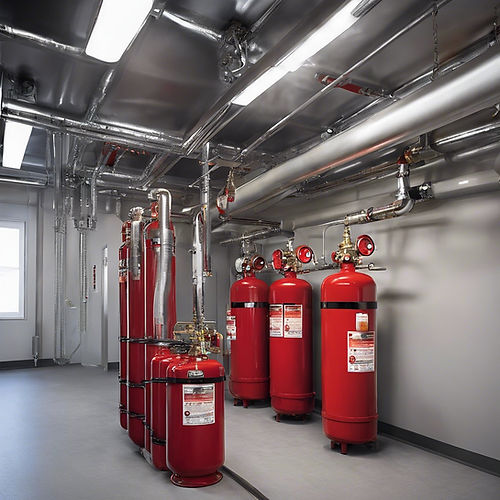
- Gas Storage Cylinders: Store suppression gas under pressure.
- Pipework & Nozzles: Distributes gas through pipes.
- Manual Activation Stations: Allow manual system discharge.
- Warning Devices: Visual and audible alarms.
Common Applications
- Data Centers, Archives, Telecommunications Rooms, Power Generation Plants, and Marine Applications.
Design Considerations
- Room Sealing: Ensure airtightness for effective gas concentration.
- Discharge Time: Rapid discharge (10-60 seconds) to suppress fire.
- Human Safety: FM-200 and Novec 1230 are safe for occupied spaces; CO2 for unoccupied areas.
- Ventilation: Proper ventilation after discharge.
Fire Detection and Activation
- Automatic Activation: Linked to detection systems.
- Manual Activation: For emergency personnel use.
Maintenance and Testing
- Regular Inspections: Check cylinders, system integrity, and detectors.
- Room Integrity Testing: Ensure the room holds gas concentration.
Advantages of Gas Suppression Systems
No Residue, Rapid Response, and Minimal Damage.
Disadvantages
Cost, Room Integrity Requirements, and Safety Concerns (CO2 systems).
Key Standards
NFPA 2001, ISO 14520, EN 15004, BS 5306-4